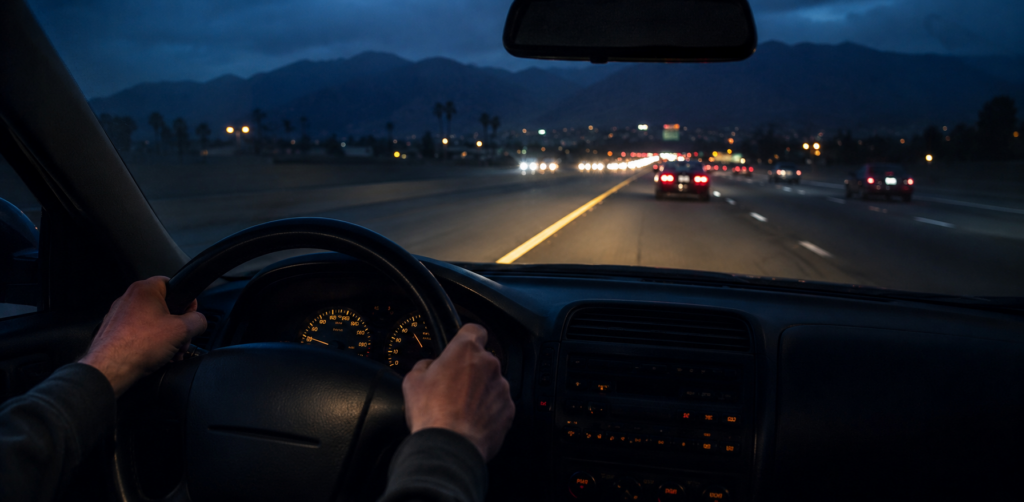
If a drowsy driver caused your car accident in Pasadena, you deserve a drowsy driving accident lawyer who knows how to prove fatigue behind the wheel. Unlike a drunk driving accident case, where blood alcohol content provides clear-cut evidence, drowsy driving leaves behind subtler clues that demand aggressive investigation.
Drowsiness is not a minor lapse. NHTSA recorded 644 deaths in drowsy-driving-related crashes nationwide in 2024. A drowsy driving injury lawyer can examine the full circumstances, explain your options under California law, and deal with insurance companies while you focus on medical care. Free consultations are available in English and Spanish.
The Law Offices of Pius Joseph represents car accident victims across Pasadena and the San Gabriel Valley who have been seriously hurt because someone fell asleep or was too fatigued to drive safely. We handle every step of the legal process. Call us for a free consultation.
Is Drowsy Driving Negligence in California?
Yes. Under California law, driving while dangerously tired can constitute negligence and, in serious cases, gross negligence. Every negligence claim requires four elements: a duty of care, a breach of that duty, causation, and damages. When a driver has reason to know they are too fatigued to operate a motor vehicle safely, continuing to drive breaches the duty every motorist owes to others on the road.
Gross negligence raises the bar further. California courts have recognized that a driver who ignores obvious warning signs of fatigue — microsleep episodes, repeated yawning, or drifting across lanes — may demonstrate conduct that goes beyond ordinary carelessness.
The severity of that impairment is measurable. According to the Centers for Disease Control and Prevention, a person who has been awake for 18 consecutive hours drives comparably to someone with a blood alcohol content of 0.05 percent. At 24 consecutive hours awake, performance resembles a BAC of 0.10 percent — above California’s 0.08 percent legal limit. A driver who continues on the road in that condition is not merely tired.
Proving liability in drowsy driving cases often depends on showing that the driver knew or should have known the risks of driving while fatigued, which makes documentation of the driver’s condition before the crash essential.
How We Prove a Driver Fell Asleep
Drowsy driving cases can be harder to prove than DUI cases because there is no breathalyzer or blood test for fatigue. The scale of that measurement gap is significant: while police-reported data attributes roughly 1.6 percent of traffic deaths to drowsy drivers, an AAA Foundation study using in-depth crash investigations estimated that roughly 17.6% of fatal crashes involved a drowsy driver between 2017 and 2021. Fatigue is routinely present and routinely unrecorded.
That is why evidence must be preserved quickly, and why attorneys send preservation letters early. Proving a driver was asleep or dangerously fatigued requires evidence from multiple sources:
- Event data recorder (black box) data — Most modern vehicles record speed, braking inputs, and steering behavior in the seconds before a crash. Gaps in braking or erratic steering can indicate that a driver lost consciousness.
- Surveillance and dash-cam footage — Traffic cameras or nearby security cameras may capture lane drift, failure to brake, or other signs consistent with falling asleep at the wheel.
- Witness accounts — Passengers, other drivers, or bystanders who noticed head nodding, closed eyes, or weaving before impact provide critical testimony.
- Phone and device activity records — Timestamps showing inactivity or late-night usage patterns can corroborate fatigue.
- Hours-of-service logs and employer records — For commercial drivers, electronic logging devices and dispatch records reveal whether rest requirements were met or violated.
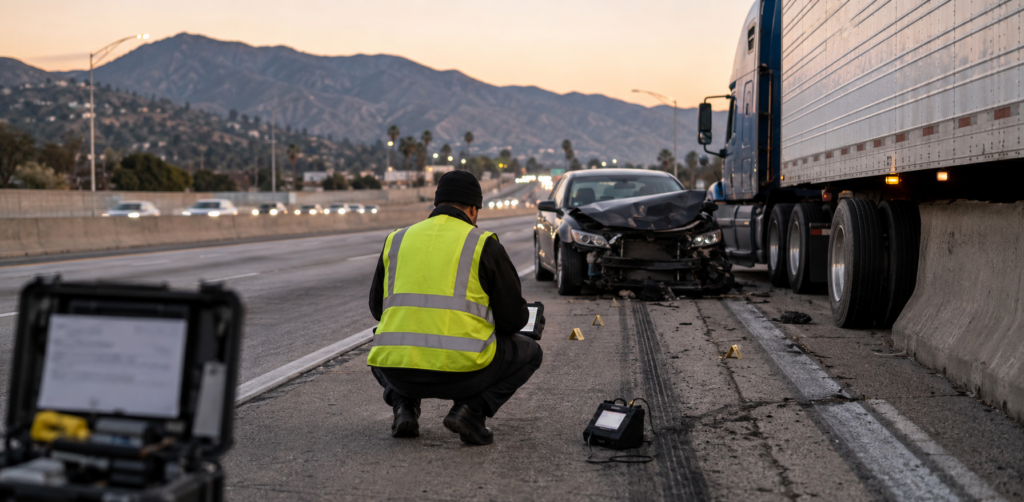
- Accident reconstruction — These experts analyze skid marks, the point of impact, and vehicle trajectories. A complete lack of evasive action often indicates driver fatigue.
- Expert testimony — Sleep medicine specialists and toxicologists can testify about the effects of sleep deprivation, medical conditions like sleep apnea, or sedating medications.
Other evidence of fatigue may include work schedules, GPS logs, and hotel check-in records. Police reports can be important in determining fault and may contain the driver’s own admission of feeling tired. We gather evidence quickly — before black box data is overwritten or recordings are erased.